Sustainable Growth

Sweden offers a practical example of how forward-looking energy and sustainability policies can attract investment, strengthen industrial competitiveness, and create jobs.

Investing in Sustainability Drives Competitiveness and Growth

Sweden’s experience demonstrates that economic growth and climate action can reinforce one another. Since introducing a carbon tax in 1991, Sweden has significantly reduced greenhouse gas emissions while growing its economy and strengthening its position as a global innovation leader. Today, Sweden combines a highly competitive business environment with one of the world’s lowest-carbon energy systems. The transition is increasingly driven by business opportunity. As industries electrify and demand for clean energy grows, Sweden is investing in the infrastructure needed to support the next generation of manufacturing, transportation, and AI-driven technologies. The country’s long-term goal is to achieve climate neutrality by 2045, supported by an electricity system built around fossil-free power from hydropower, wind, and nuclear energy.

A Platform for the Industries of the Future

Sweden’s green transition is powered by collaboration between government, industry, academia, and local communities. Longterm policy goals provide certainty for investment, while businesses develop the technologies and solutions that turn ambition into economic opportunity. This collaborative model is particularly visible in energy-intensive sectors, including advanced manufacturing and digital infrastructure.

As demand for AI and cloud computing accelerates worldwide, Sweden has become a testing ground for sustainable data-center development. Access to fossil-free electricity, reliable grids, and innovative energy partnerships enables data centers not only to operate efficiently but also to become part of the energy system itself.

​​​​​​​In Stockholm, excess heat generated by data centers is captured and fed into the district heating network, warming homes instead of being wasted. What is traditionally viewed as a byproduct becomes a resource, illustrating how circular thinking can transform infrastructure into a source of both economic and environmental value. By 2022, recovered heat from participating facilities was sufficient to heat approximately 30,000 apartments annually
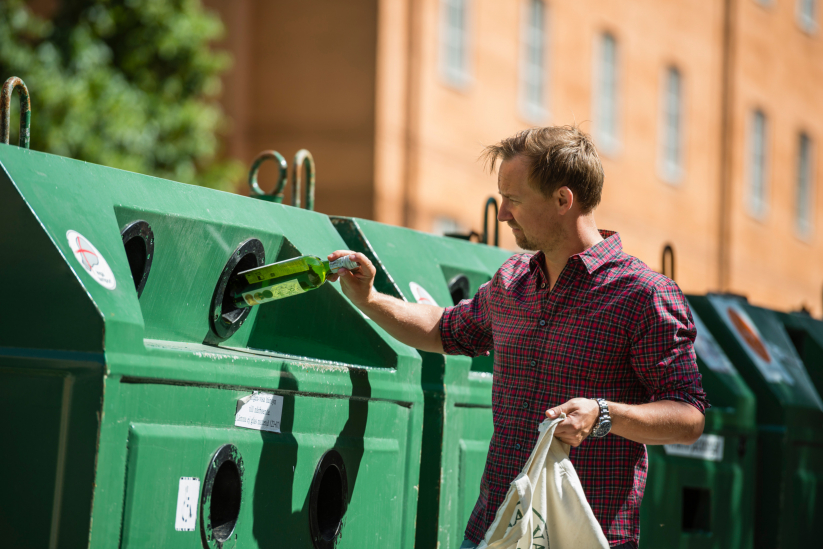
Man recycling bottles in Sweden
recycling bottles
Circularity is part of everyday life in Sweden. From household recycling and depositreturn systems to industrial heat recovery and resource-efficient manufacturing, Swedish communities and businesses work together to keep materials and energy in use for as long as possible. Increasingly, the same circular mindset is being applied to the digital economy, where excess heat from data centers is reused to warm homes and reduce emissions. imagebank.sweden.se
ulf_lundin-power_from_water-5810
Sweden’s extensive network of rivers supports one of Europe’s largest hydropower systems, making hydropower a key source of the country’s fossil-free electricity. imagebank.sweden.se

Circular Thinking as a Competitive Advantage

In Sweden, circularity is not limited to recycling. It is an economic strategy focused on extracting more value from energy, materials, and resources while creating new business opportunities. The national circular economy strategy promotes innovation, resource efficiency, and sustainable growth across entire value chains. This approach is increasingly relevant to challenges facing the United States, from growing energy demand and AI expansion to supply chain resilience and access to critical materials. Sweden’s experience shows how waste streams can become valuable inputs. Food waste becomes biogas, industrial excess heat warms communities, and products are designed for reuse, repair, and recycling. Circular solutions are also embedded in everyday life. Sweden’s well-known deposit-return system for bottles and cans achieves among the world’s highest collection rates, while businesses and municipalities continue to expand reuse, repair, and resource-recovery systems. As energy demand from AI and data centers continues to grow, Sweden’s approach offers an important lesson: the most sustainable resource is often the one already in the system. By viewing waste, heat, and materials as assets rather than liabilities, circular thinking can reduce costs, strengthen resilience, and unlock new economic opportunities